
Digital Product Passports for distributors: is your product data ready?
Digital Product Passports are being introduced across the EU from 2027. This means distributors will have to make significantly more information about their products available throughout their lifecycle. Here we look at what this means for your product data and the next steps you should be taking.
Product information tends to build up over time. The ERP holds one part of it. Marketing has the images. Technical documents sit on a shared drive. Purchasing has supplier spreadsheets. Compliance keeps certificates somewhere else.
Meanwhile, retailers are asking for better descriptions and imagery. Ecommerce teams need detailed specifications. Sales reps need accurate product information when they’re with customers. Marketplaces want structured data in their own formats.
Now Digital Product Passports, or DPPs, are adding another requirement.
So while there’s understandably a lot of discussion about the regulation itself, the important question is, when you needed to pull together detailed, accurate information for 10,000 or 20,000 products, how easy is that going to be?
What is a Digital Product Passport?
A Digital Product Passport is a digital record of information about a physical product.
The EU is introducing DPPs as part of its plans for more sustainable products and a circular economy. Rather than useful information disappearing once a product has been manufactured or sold, the intention is to keep that information connected to the product throughout its lifecycle.
Exactly what needs to be included will depend on the product and the regulations that apply to it. It could cover materials, origin, environmental performance, repair, recycling, compliance and other product characteristics.
There isn’t a single deadline when every product suddenly needs a passport. Requirements are being introduced by product group, with different rules and timescales.
This isn’t a case of ripping out existing systems and starting again, but it does require carefully looking at what you already have and how data retrival can be streamlined. Particularly if product information has grown across several systems, departments and spreadsheets over the years.
Why could DPP become a product data problem?
Take a distributor with 20,000 SKUs.
The ERP contains the SKU, description, price, stock level and supplier. Marketing has the photography. Technical specifications are stored in PDFs on a shared drive. Purchasing has the latest supplier spreadsheet. Certificates are held by another department. Packaging information lives with the operations team.
Some of it may only be easy to find because one particular person knows where it is.
None of this is unusual. And it works until you need to bring a much broader set of information together for every product, keep it current and make it available in a consistent format. It’s at that point simply having the information isn’t enough.
DPP is likely to expose any gaps in your data processes quite quickly.
Isn’t all our product information already in the ERP?
Probably not, which isn’t necessarily a problem.
ERP systems are built around the operational side of the business. Stock, pricing, purchasing, customers, orders and other transactional information.
Product information has become a much bigger job.
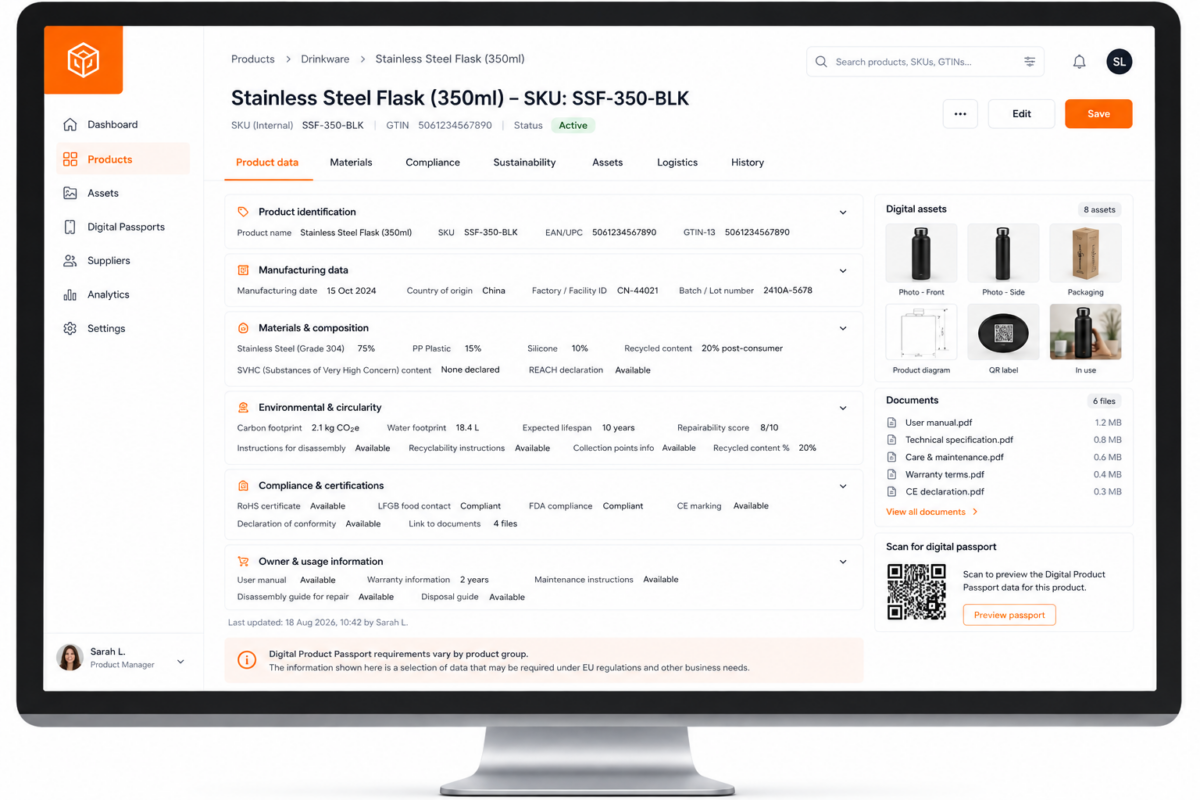
One SKU might now have dimensions, materials, technical specifications, descriptions, certifications, safety documents, sustainability information, multiple images, videos and downloadable documents attached to it.
Trying to make the ERP hold and manage all of that isn’t always the best answer. The question is what information your ERP should own, what should be managed elsewhere and how those systems exchange information.
For many distributors, it’s worth finding out whether DPP applies next year or several years from now.
Product information is already being used everywhere
It’s easy to look at Digital Product Passports as another compliance job. But product data isn’t only used for compliance.
A rep sitting with a retailer needs specifications, images and accurate product details. A trade customer ordering online needs enough information to make a buying decision without having to ring someone. Retailers regularly ask suppliers for product data and images for their own websites. Marketplaces want structured feeds. Marketing needs photography, descriptions, technical documents and other assets.
Very often, each of those requests starts another hunt for information.
That’s where we’d like you to look beyond the passport itself.
Instead of working out how to assemble one set of information specifically for DPP, it makes more sense to get the underlying product information into a state where it can be used wherever it’s needed. This then solves a problem the business already has.
How ready is your product data?
You don’t need to know every future DPP requirement to start looking at this. A few practical checks will give you a good idea of where your product data stands today. Pick a reasonable sample of products, wprk through this table and see what you can find.
Where do PIM and DAM fit?
This is where Product Information Management, or PIM, and Digital Asset Management, or DAM, start to make more sense.
A PIM gives businesses somewhere to manage the richer product information that doesn’t naturally belong in the ERP.
A DAM does the same for assets such as photography, videos, certificates, manuals and other documents.
For a distributor with a large product range, the value is fairly practical. There’s a known place for the information, a known version of it and a way to make it available to other systems.
Aspin’s SkooCloud combines PIM and DAM capabilities for this reason.
Product information and digital assets can be managed centrally and then made available to the places they’re actually used. That might be ecommerce, sales applications, catalogues or other digital channels.
If DPP creates another place that needs product data, it becomes another destination rather than another separate data exercise.
DPP is a good reason to look at product data properly
There’s still plenty to be decided as Digital Product Passport requirements are introduced across different product groups.
Businesses will need to look at the rules that apply specifically to their products rather than trying to prepare for every possible requirement now.
But you can still do something useful in the meantime.
Find out where your product information lives. See how complete it is. Work out who owns it. Look at how many times the same information is being maintained.
Because better product data is useful long before it reaches a Digital Product Passport.
Sales reps can find what they need when they’re with a customer. Ecommerce product pages are more complete. Retailers get consistent information. Marketing doesn’t have to hunt through folders for the latest image or document.
And when another channel asks for product data, you’re not starting from scratch.
DPP might be what prompts businesses to look at this now.
What matters is whether you could find, trust and distribute the information for your whole product range if you were asked for it.
How Aspin can help
If looking at your product data reveals information spread across an ERP, spreadsheets, shared drives and different departments, the next step is getting it into a more manageable structure.
That’s where Aspin can help.
SkooCloud gives distributors and manufacturers a central place to manage product information, images, documents and other digital assets. It works alongside your ERP, providing somewhere to manage the richer product information that sales, ecommerce and your customers increasingly need.
Combined with PixSell and InterSell, that same information can then be used across field sales and B2B ecommerce, rather than being maintained separately for each channel.
That puts you in a much better position for DPP as requirements develop, while making your product information more useful across the business today.
Want to talk about how you’re currently managing your product data? Call our team on 01795 500 200. Or drop us a line here.
Related Articles